

THE WAGER
As the Winter Olympics approach, my thoughts have returned to Cortina d’Ampezzo — the alpine town that, in 1956, quietly altered the course of hockey history. That was the year the Soviet Union made its Olympic debut, impressing with a style of play that would soon remake the sport, even as one of its chief architects, Anatoly Tarasov, was forced to watch from the stands. Sidelined after political clashes and losses, Tarasov arrived in Cortina not behind the bench but among the spectators, charged with observing the team he had helped invent without being allowed to touch it. It was a painful vantage point, and a formative one. It is also, in quieter ways, the position from which I find myself telling this story now — once close to the ice, now watching from the stands.
The story begins with Bill Cleary, a Harvard forward skating for the United States that winter, and one of the few Americans who would come to know the Soviet team not as abstractions or enemies, but as people. Over the years, Bill and I have spent long hours on the phone together, circling back to Cortina, to the small moments between games, and to a sideline wager involving a bottle of vodka that outlived the Cold War itself.
I’m sharing this now, on the eve of Cortina’s return, because the Olympics have always been more than sport: they are a stage for myth, memory, and the complicated, fragile hopes we carry forward.
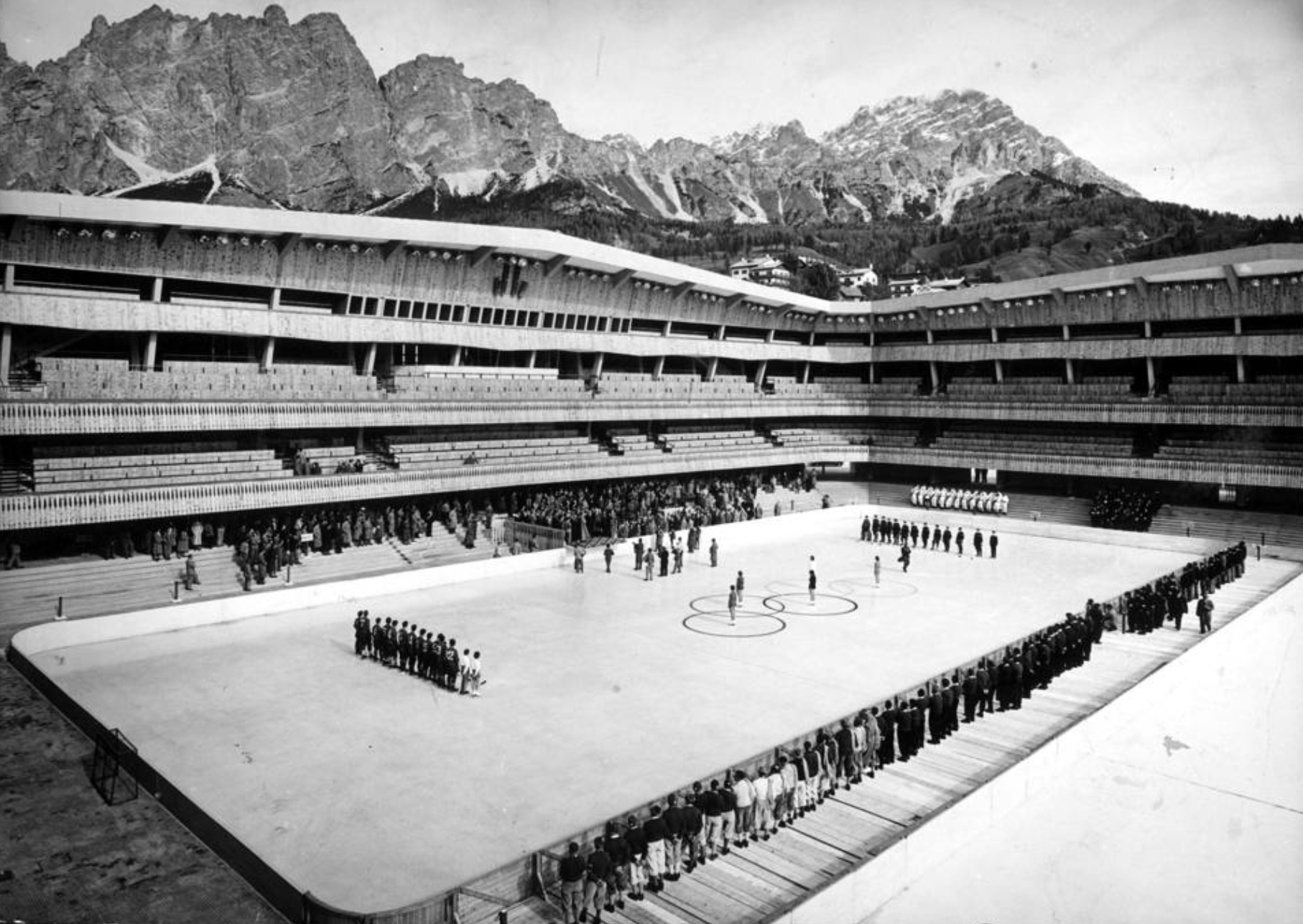
The outdoor Olympic venue in Cortina d’Ampezzo, 1956. IOC.
For a man who never drank, Bill Cleary possessed an astounding amount of Russian vodka.
The first bottle was the winning prize of a bet with a Soviet translator on the sidelines of the 1956 Olympics in Cortina d’Ampezzo, where Cleary, a Harvard forward and rising star of American hockey, represented the United States.
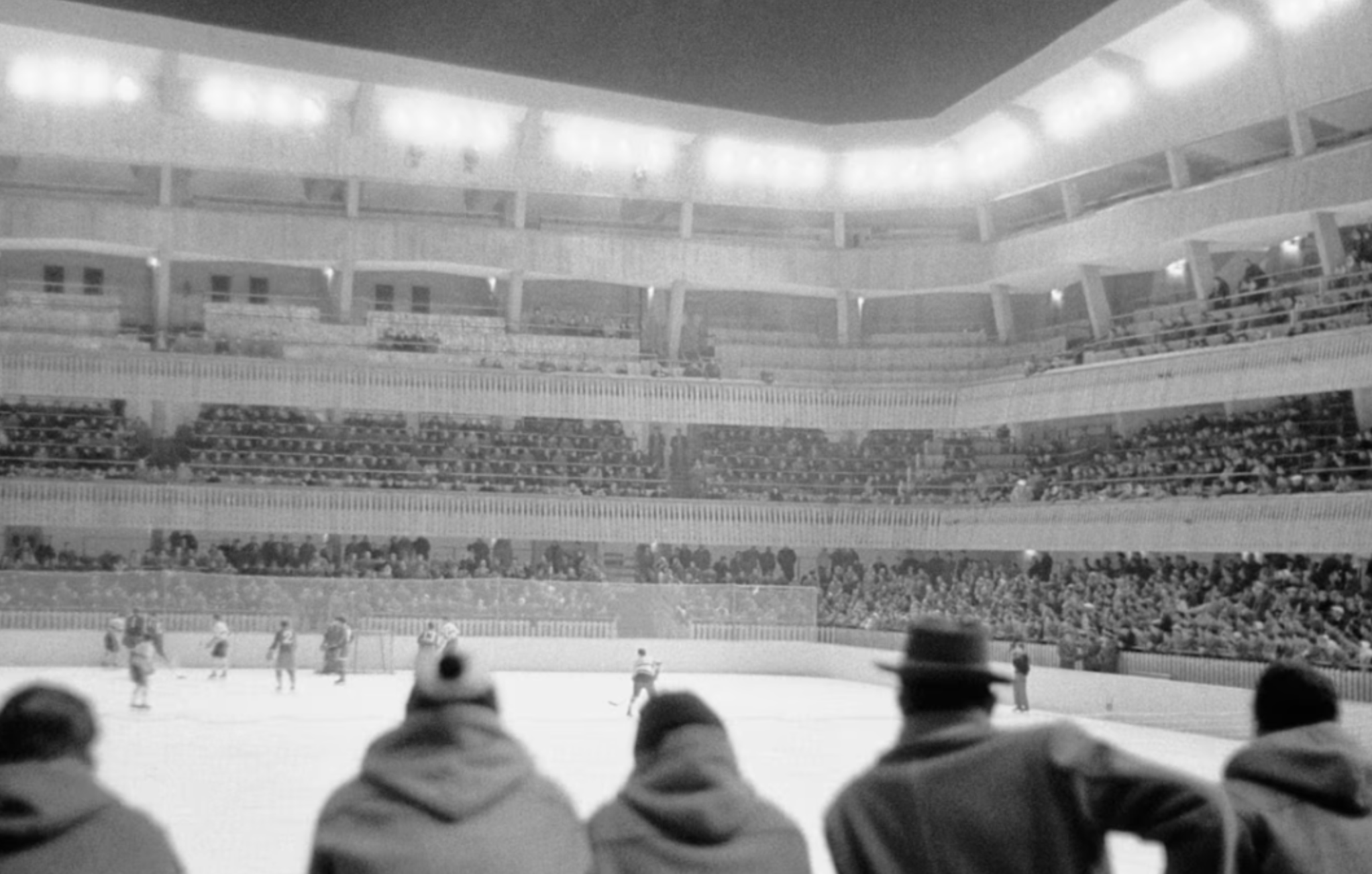
Both Cleary and the Soviet Union were making their Olympic hockey debuts against an enchanting backdrop. The crescent-shaped Olympic Stadium rose between the peaks of the Dolomites, hockey matches staged in the open air under a sky full of stars. “You thought you were looking at heaven upstairs,” Cleary recalled to me nearly seventy years later. “It was utterly magnificent.” Before the construction began on a roof, the outdoor venue made a memorable appearance in the 1981 James Bond film, For Your Eyes Only. Listening to Cleary on one of our regular calls, I closed my eyes and imagined the Olympic Flame dancing in the alpine wind, the air so cold it felt sacred — a world that still existed, despite decades of distance, in a cherished corner of his memory.
In light of Cortina’s future ties to literature’s most famous spy, it felt apt that Cleary was on a reconnaissance mission that day. The unbeatable Canadians were facing a forgettable opponent, and he wanted to size up what the United States would soon contend with on the ice. Among the crowd — unbeknownst to Cleary at the time — was the firebrand Anatoly Tarasov, a member of the Soviet delegation. He had been relegated, as he often would be throughout his life, from coach to spectator after a string of poor showings and spats in the years before Cortina. Despite his seat in the stands, Tarasov looked every bit the part of a bench boss: an ushanka and wool coat over shirt and tie, the letters CCCP sewn in white across his heart. He turned out to be the most eager Olympic correspondent posterity could have asked for, recording in assiduous detail his observations of the games, the atmosphere, the Soviets’ triumphs and pitfalls, and the nature of the competitors. His accounts were published in the Soviet magazine Sports Games, a monthly periodical that ran from 1955 to 1994.
Tarasov’s generosity in his demoted role struck me as profound, as if the spirit of collective play he infused in his players was not a coaching tactic or political slogan but a thread in the fabric of how he moved through the world. I envied the passion he reached for in a moment when I might have drowned in my own bitterness. I wondered about the disappointment he carried with him to Cortina.
Stood in a corner section of the arena reserved for athletes, Cleary and his teammates chatted with the Soviet team interpreter, Roman Kiselev. Of course they were afraid of the Canadians, Cleary recalled, but who wasn’t? Although the USSR had made remarkable strides in a miraculously short amount of time, the Olympic Games were a public litmus test, a step beyond the previous World Championships in visibility and prestige.
Kiselev asked Cleary if he felt that America would beat Canada. With hallmark, Harvard boy confidence, Cleary responded, “Absolutely.”
“I will give you a bottle of vodka if you beat them,” Kiselev replied.
Whether self-fulfilling prophecy or a stroke of luck, Cleary turned out to be right. “We beat Canada in ‘56 and ‘60,” he offered with smug pride. “I love to tell [Canadians] that, because they don’t like it.” Alongside a collection of hockey equipment and trading pins, Cleary tucked a bottle of Russian vodka into his suitcase—not to mention a silver medal. Both were shocking achievements in light of the New York Times dismissal of the 1956 U.S. team as an also-ran.
Much to the delight of the interpreter, the Soviets beat Canada too—and America, for that matter—en route to its first Olympic Gold Medal in hockey. Under the leadership of the measured and brilliant Arkady Chernyshov and fortified by Anatoly Tarasov’s Red Army players, the USSR dazzled crowds with their endless, clever passing plays and acrobatic goaltending in Leningrad native Nikolai Puchkov. For the tight matchup against the yet-undefeated Americans, the New York Times was swift to note that the crowd was against the Soviets:
With the majority of the 12,700 fans who packed Olympic Stadium rooting against them, the Russians tallied with the aid of a questionable penalty call against the Americans in the second period and scored three goals in the final period.
Tarasov also took note of the charged atmosphere, with particular attention to how the fans celebrated in the stands. “The Olympic Ice Stadium had no empty seats on that day,” he observed. “American fans came to the stands with their national flags and weighty bells, the ringing of which was supposed to cheer the U.S. team.” But what of the questionable tripping penalty?
The Times wrote that Soviet forward Alexander Uvarov took a tumble after American forward Gordon ‘Ginny’ Christian had already turned away from him, negating any form of intentionality. In Tarasov’s account, the victim of the alleged trip was Yevgeny Babich. Cleary could not remember what exactly had transpired. Between the detailed recollections of plays and momentum changes, the glimmers of Tarasov’s personality and biases in the Cortina chronicles were the most memorable. His coverage of the penalty on perhaps Babich, a forward whose collective mentality and playing style he adored, revealed so much in so few words. “Yevgeny Babich plays selflessly, but he had suffered several, serious injuries before this meeting,” Tarasov explained, setting the stakes for the injustice that followed. “He reaches the opponent's zone, goes around the American defenseman, and prepares to pass the puck to Bobrov, but at that moment he is rudely knocked down by the American defenseman. The referees fairly remove the offender from the ice.”
Rudely knocked down by an American opponent—I laughed reading those words, imagining Tarasov’s hands gesturing with animation in the stands. The audacity! And it was worth noting that Ginny Christian, the American most often associated with the call, was in fact a forward, not a defenseman — a small but telling blur in his account. Tarasov had strong aversions to the brute force of North American play—a subject on which he would opine, and a tactic he would be forced to mitigate, for the rest of his coaching career. Cleary was unimpressed with the European officiating, which he perceived to share Tarasov’s distaste for body checks and the more physical style of the North American game. “Some of the refs could hardly skate,” he added with a laugh.
While perhaps not the bastion of objectivity, Tarasov did turn a critical eye to the Soviet team in his reporting as well, lamenting moments when the players were selfish with the puck to the detriment of the team:
“As soon as the opponent gets close to [winger Yuri] Pantyukhov, he gives it to [center Alexey] Guryshev, who, in turn, gives it to the defenseman. The opponents cannot take possession of the puck for more than a minute,” Tarasov explained of a tense moment in the matchup with America, a representation of the dogged Soviet possession that drove opponents to madness. Forward John Matchefts would later tell USA Hockey Magazine that he estimated the USSR had the puck for a whopping seventy-percent or more of the game.
“This is where Pantyukhov falls victim to his excessive self-confidence. Carried away by the individual game, he gets pretty tired and, trying to avoid another opponent, loses the puck. Only the composure and skill of [goaltender Nikolai] Puchkov saves our team from another goal.”
Crisis averted, the exhausted and frustrated Americans fell apart in the third period, conceding three goals in rapid succession. The Soviets defeated them 4-0, with Sovietsky Sport taking particular account of the superstitions of the American players, a defining facet of Russian culture that they found reflected in their rivals.
“The Americans congratulate the winners, but even here, the U.S. hockey team stays true to their omens,” the magazine recounted. Did I detect humor or a touch of approval in those words? “Leaving the ice, goalkeeper [Willard] Ikola throws his stick on the ice. As he explained later, this stick brought him bad luck, and he will not play with it anymore.”
Soviet reporters were equally swift to note the interest that the Canadians had shown in Yuri Pantyukhov, who sported the unlucky number thirteen by Western standards. In defiance of the jinx, the number would become something of a talisman for Russian players in the years to come. NHL superstar Pavel Datsyuk, for example, wore thirteen throughout his career, as did Detroit Red Wings Russian Five member Slava Kozlov and skilled forward Valery Kamensky, who scored ten postseason goals when Colorado defeated Detroit for the Stanley Cup in 1996. I loved the fact that hockey players across the iron divide were united in superstition, even if their protective charms stood in polar opposition. I imagined a parallel skirmish being waged in an alternate dimension — sticks blessed by fortune and digits cursed by superstition hurling bolts of lightning, a private war fought in mythic defense of those who carried them.
The Soviets shut out Canada twenty hours later to be crowned Olympic, World and European champions. In their first-ever appearance at the Olympics, the Soviets swept the field. I found grainy highlights of the Finals in the IOC archives, partially colorized and layered over a chirpy jazz loop that made the triumph feel, momentarily, like a cartoon. As goaltender Nikolai Puchkov skated to center ice to embrace his teammates, he kicked his leg into the air with the agility of a Radio City Rockette. As the Russians and Canadians shook hands, some of the players traded sticks with one another.
Bill Cleary returned to the Olympics four years later on home turf in Squaw Valley, California, where Tarasov was given another chance to lead the Soviet bench. The Americans defeated both Canada and the USSR to win an improbable gold medal in 1960—often touted as the “forgotten miracle.” A tally from Cleary clinched the gold, and Tarasov forever joked that the young Bostonite had subsequently gotten him fired from the National Team. Again.
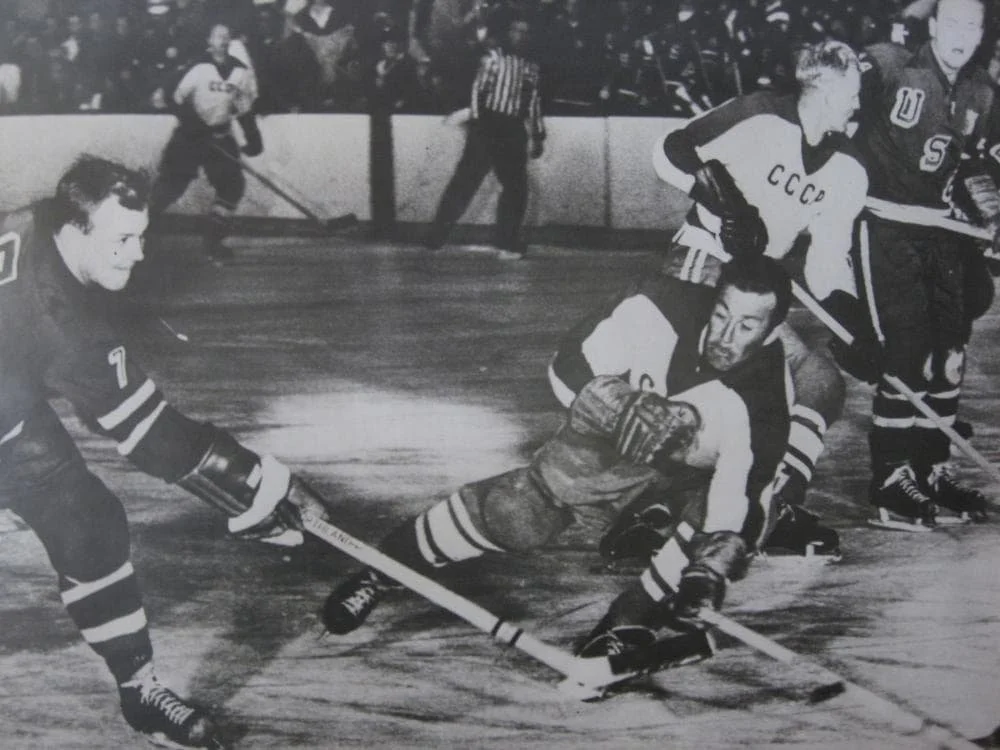
Bill Cleary scoring against the Soviets in Squaw Valley, California in 1960.
But none of that mattered two decades later, in the summer of 1979, when Tarasov was seated in Cleary’s backyard in Massachusetts, years after his spectacular run and final displacement from the Soviet National Team. Another bottle of vodka was gifted to Cleary that night, this time from Tarasov himself, who had long forgiven the loss of 1960. In fact, the pair of sporting enemies counted themselves as friends. Twenty years prior, when the Soviets played exhibitions at Madison Square Garden over New Year, Cleary had wanted to watch the games but did not have a ticket. An attendant took him down toward the U.S. locker room to sort out the issue, but en route, it was Tarasov who interceded on his behalf.
As the evening wrapped, Tarasov lifted a bottle to his American host. “One last thing, Bill,” he announced with his usual theatrical flourish. “I want to wish your team best of luck in 1980. Sincerely, I have a bottle of vodka in my hand, homemade. The real Russian vodka. You can’t open this bottle until the U.S. wins an Olympic Gold Medal. And it can last in this bottle for two hundred years, so we have time.”
Tarasov threw the bottle into a tangle of reeds along the bank of the Charles River for effect, as if the wager was too absurd to ever warrant a toast. After his guests had left, Cleary ran back to retrieve it.
Eight months later, the United States claimed an improbable, earth-shattering gold medal on a muddy February day in Lake Placid. En route, they defeated the favored Soviets in a game that holds perhaps the most sacred place in U.S. lore — the Miracle on Ice. It was a vanquishment that transcended sport. The Miracle game was billed as a showdown between American audacity and Soviet rigidity — a triumph of democracy over communism at the height of the Cold War. President Jimmy Carter sent several military planes, Air Force One included, to deliver the Olympians to Washington D.C., where thousands of fans greeted them before a White House reception. Years later, a U.S. Navy veteran would tell me that his submarine taped a hockey stick to the periscope after Lake Placid, which they raised in taunt each time a Soviet vessel drew near. Despite the posturing and militaristic pomp, two words continued to flash in my mind: and yet.
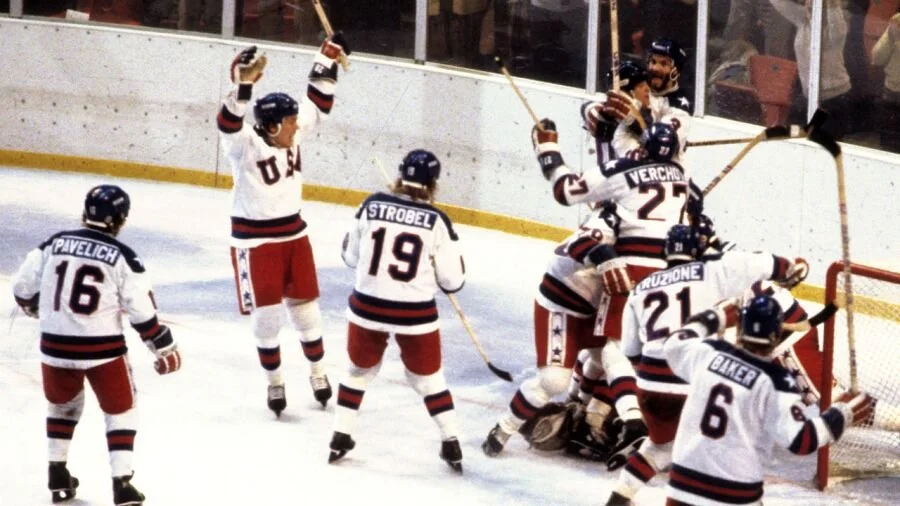
Celebrations abounded when the U.S. beat the Soviet Union in 1980 - a victory so improbable that it was deemed the “Miracle on Ice.” IOC.
And yet, even that clash — that mythic collision of flags and fates — could not erase the strange, human affinities that had been seeded years before in Cortina. When I asked Cleary about those vodka wagers decades later, he did not frame them as rivalry. He spoke instead of shared jokes, of traded barbs on snow banks, of foes becoming friends. A photograph taken of Cleary and his brother alongside members of the Soviet team was a mainstay on his mantle. Years later, a longtime member of the Soviet roster–Konstantin Lokhtev–would share with Cleary that the same photograph lived on his refrigerator at home in Moscow.
In this strange alchemy, where vodka and competition, memory and myth intertwined, I discerned the real miracle: how sport, at its best, made room for contradiction and for grace. I wondered as Bill spoke, and even more so now, whether we could dare to hope for such fragile and unfashionable things — the moral inconvenience of friendship across poisoned divides, in a world where sympathy and empathy had been flattened into synonyms, and too often mistaken for treason.
Russia will not return to Cortina in 2026. Its Olympic Committee remains suspended, and national teams are barred under IOC sanctions imposed after the invasion of Ukraine. There will be no need to reference an anniversary — to seventy years since the Soviets won an improbable gold — nor the coach who once sat in those stands. No unlikely friendships between East and West will form in the quiet intervals between breakfast and morning skate. And, much like Tarasov in Cortina, I watch hockey from a distance — a former Olympic studio analyst, now a spectator brimming with things to say.
Perhaps I reach for this story today because I sense a flicker in its margins — a hope that still dares to announce its presence, even as I question the role it serves in the current state of things. It may be nothing more than the coming majesty of the Dolomites on a television screen, or the heart-pounding drumbeat of John Williams’ Bugler’s Dream beneath my morning coffee, playing again in primetime as I drift off to sleep. Or perhaps Tarasov is calling to me once more — as he so often has throughout my career — his voice achingly familiar, though I never heard it beyond a screen. Sitting four thousand miles from Cortina, I wonder if telling this story anyway is the assignment, much as Tarasov spent 1956 scribbling in a notebook, watching from the stands, and wearing his heart on his sleeve.
What if, in exile, there is still work to be done?
That is his wager with me.


